Zhang Xuefeng Is Gone. Let Me Talk About My Health System
- No.
- 128
- Date
- Read
- 7 min
- Words
- 1,479
Last night, the news of Zhang Xuefeng's death swept through everyone's WeChat Moments, and countless people mourned the loss of someone born in the 1980s.
The one who has gone is gone, and the living go on. What can we take from his death?
With his passing, countless eyes turned to the cause of death: sudden cardiac death.
For me, the phrase "sudden death" has seemed to be in my ears all my life. Just when I'm about to forget it, there's a news story, or I hear an adult say that so-and-so has dropped dead again.
My first rough idea of sudden death was probably this: someone is run-down, very active, doesn't rest properly at night, keeps living like that for a long time, and then drops dead.
It turns out that more than ten years on from my childhood, sudden deaths still happen from time to time. Surely the ghost of sudden death isn't circling only me, while everyone else in the world has never felt its terror?
The causes of sudden death roughly include:
Cardiac causes:
- Coronary heart disease: long-term myocardial ischemia
- Arrhythmia: such as ventricular fibrillation, which makes the heart stop pumping blood
Lifestyle and external factors:
- Overexertion: long-term late nights and intense work leave the sympathetic nervous system overstimulated
- Extreme emotion: stress cardiomyopathy triggered by rage, deep grief or violent fright
- Intense exercise: exercising beyond what your body can handle without being evaluated first.
So given these causes, what can we do about sudden death?
For cardiac causes, what we can do is get regular checkups to see whether we're at risk of coronary heart disease.
For lifestyle and external factors, everyone can take plenty of action to improve them.
Chatting with other members in a group chat, I noticed everyone sighing over Zhang Xuefeng dying so young, and at the same time turning to their own lives, saying they often stay up late too, keep irregular hours, and so on.
Then someone said they'd start going to bed earlier from today.
I feel like I've seen this script many times. Whenever someone dies young online, apparently from overwork, countless people mourn and panic, fearing the same fate someday, and then change their habits for a short while.
But in fact, what most people truly lack is a "health system" that can run steadily and continuously. A day or a week of "healthy living" is far from enough.
Chatting with the group, I had a strange feeling that their lifestyles didn't seem very healthy, and in a daze I came away feeling that my own life is actually fairly healthy.
Why did I feel that way? I divided my system of health management into seven dimensions and made a radar chart. If you're interested, you can score yourself on these seven dimensions too.
- Sleep: My average sleep has stayed around eight hours, and I feel good.
- Exercise: Averaged over a year, I have about 15 exercise days a month, including strength training, cardio and other types.
- Emotion management: I'm an optimist. Even if life deals me a heavy blow, I won't be overcome with grief, and extreme emotions usually calm down quickly after they hit.
- Diet management: I haven't been eating healthy for long, but it's been almost a year. "Healthy eating" is hard to define. For me it's basically a low-fat diet with high carbs and high protein as the main pillars, plus some fiber and vitamins. I have a few indulgent meals a month, but overall it's much healthier than before.
- Lifestyle habits: I don't smoke, and I drink occasionally.
Weighing these five dimensions rationally, I seem to be quite healthy. At the very least, I can say my lifestyle is "relatively" healthy.
The reason I've been able to keep these habits long-term is that over the past year I've built my own "health system." The key word is system, and what it serves is a healthy life.
A healthy life is nothing more than a healthy body and a healthy mind.
109 years ago, a young Mao Zedong wrote in "A Study of Physical Education": **"civilize the mind, toughen the body"**, and I took that line as the guiding principle of my system, and used it to build the whole system of physical and mental health.
For physical health, I currently assess four dimensions:
- VO₂ max: an indicator of aerobic capacity. For details, see my post on VO₂ max
- Strength: Strength is a broad word, but I think it essentially means a person's muscle mass. The more muscle, the more weight you can theoretically lift.
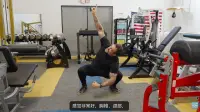
- Balance: If VO₂ max and strength are the main frame of physical health, then balance is like the support brace. Many people instinctively overlook it.
- Flexibility: If balance is the support, flexibility is the body's lubricant. Without enough support and lubricant, even great strength is useless.
My training plan revolves around these four dimensions:
- VO₂ max: I train my aerobic ability through cycling, and train my VO₂ max with a certain amount of hard riding. My VO₂ max is currently above average for my age.
- Strength: I train with traditional push, pull and squat machine work. My strength is probably below average for my age right now, but I've made big progress compared with a year ago.
- Balance: This is the weakest part of my training. I don't have a structured routine, but I do it once or twice now and then.
- Flexibility: Flexibility is really about stretching. The saying "an inch more in the tendons adds ten years to life" stresses the importance of stretching and flexibility. I do this almost every day now, because it has no intensity and a very low barrier to start.
For mental health, I think a few dimensions are unavoidable:
- Sleep: Sleep is the foundation of everything, and it's closely tied to the body too. Poor sleep makes you feel bad, and it also affects your emotional stability to a degree.
- Emotion management: I haven't looked into emotion management much. But in traditional Chinese medicine, the Yellow Emperor's Inner Canon says: "joy harms the heart, anger harms the liver, overthinking harms the spleen, sorrow harms the lungs, fear harms the kidneys," which can't be for nothing. Emotion management must have to do with emotional steadiness, and being "not delighted by outer things, nor saddened by one's own lot" is probably the ideal it aims for.
On both fronts, here's what I've learned from practice:
- Sleep: I think sleep has a lot to do with habit. A good routine has a big effect on sleep quality. Emotions also matter a lot. If you're too happy, down or angry before bed, it hurts your sleep.
- Emotion management: In Buddhism's Four Noble Truths, the truth of suffering includes the idea of the eight kinds of suffering in life.
- They are birth, aging, sickness, death, meeting what you hate, parting from what you love, not getting what you seek, and the raging of the five aggregates.
- I think the vast majority of a person's emotional swings are closely tied to these eight.
- Even happy feelings may come from the flip side of the eight, like reunion after a long parting, or getting what you wanted.
- Of course I can't say I feel nothing about the eight. People are emotional animals. Even Wang Yangming, called a sage, cried out to the sky "Heaven has destroyed me! Heaven has destroyed me!" when his disciple died.
- So my approach to emotion management is to pursue inner peace. Our hearts are by nature an ocean of emotions, and mastering its raging waves is something to practice for a lifetime. As long as you manage that, an occasional wave won't stir up a storm that can't be calmed.
All of the above together makes up my "health system."
A system isn't a habit. The difference is that it keeps behavior running for the long term and doesn't break because of a moment of laziness.
Of course, you might think what I've described is too complicated. But with a health system, everyone can start from the simplest step.
For example, from today, take the stairs when you get home, or start going for a walk after dinner every day.
Everything has a process of development. We can't expect that one healthy day today will give us the lowest-risk body tomorrow. That's not scientific.
And don't think that the best way for ordinary people to take care of their health is to not work. I think that's making excuses for laziness and skipping over the contradictions you face. Whoever says that, setting aside whether they can afford not to work, wouldn't necessarily keep a healthy lifestyle even if they really quit.
So if you're willing, start from the simplest thing, and you can change your outside factors by a little bit.
Put in effort, get a return. Isn't that great?